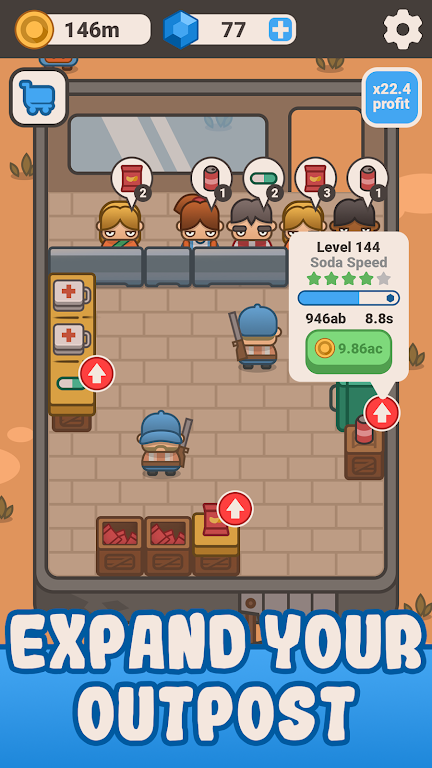
Idle Outpost: Upgrade Games drops you into a compact 2D business simulator set in a gritty post-apocalyptic world, where smart resource choices and steady upgrades determine whether your outpost survives. In this editor overview we look at how Idle Outpost: Upgrade Games combines simple point-and-click management with incremental tycoon progression: you run a trading post, acquire supplies, upgrade buildings, unlock product lines and explore varied locations from scrapyards and gas stations to hidden vaults. The description below explains the core mechanics, control style, progression flow, visual design, and what makes the game a solid pick for players who enjoy measured growth with a survival twist.
Gameplay mechanics
Gameplay revolves around a clear loop of supply, production and sales. You start with a small trading kiosk and gradually expand your product catalog by researching and purchasing new items, balancing what sells best in each location. Decisions matter: allocating resources to improve production speed, expand storage or add specialty items alters throughput and income. The game encourages planning rather than frantic clicking, with an incremental reward system that unlocks new opportunities at predictable milestones so you can see tangible progress every session.
Controls and accessibility
The control scheme is intentionally lightweight for mobile: point-and-click interactions let you select buildings, inspect resource levels and trigger upgrades quickly. Menus are designed to be readable on smaller screens, and tooltips explain each upgrade’s effects without overwhelming new players. Accessibility considerations include adjustable text size for labels and a relaxed pace option that reduces the need for rapid input, making the experience approachable for casual players and those who prefer a slower, strategic playstyle.
Progression systems
Progression in Idle Outpost: Upgrade Games is driven by both short-term goals and long-term milestones. Short runs reward you with materials and currency to unlock nearby vendors or improve efficiency, while longer-term milestones open new regions and product categories. Instead of sudden difficulty spikes, progression ramps up through expanded needs—larger inventories, new supply chains and more complex upgrade trees—so players can improve their outpost through a sequence of meaningful investments and visible gains.
Visual style and level structure
The game uses a functional 2D aesthetic that emphasizes readability over high-end graphics. Each location has its own visual identity—deserts feel dusty and sparse, forests bring muted greens, bandit camps are rough and improvised, winter hideouts present snowy backdrops, and high-tech hubs show contrasting clean lines—so it’s easy to recognize where different products perform best. Levels are structured as distinct outposts or hubs you unlock one by one; each hub has a unique layout and resource profile that encourages adjusting your strategy rather than repeating the same approach.
Customization and replay value
Customization focuses on meaningful choices: upgrade paths for buildings, which product lines to prioritize and how to allocate limited storage space. Cosmetic tweaks and simple layout adjustments let you personalize your trading post without creating pay-to-win pressure. Replay value comes from experimenting with different specialization strategies—some players focus on high-margin niche goods while others pursue volume—paired with the steady introduction of new locations and unlockable items that refresh the decision space over time.
Offline play, monetization and user experience
One of the practical strengths of Idle Outpost: Upgrade Games is that it’s fully playable offline and is presented as an ad-free experience, allowing uninterrupted sessions without a persistent internet connection. The UI places core information where you expect it, with clear icons for inventory, upgrade costs and timers. The free-to-play approach avoids intrusive paywalls; progression is primarily earned through play, and optional purchases, when present, are limited to convenience or cosmetic items rather than necessary progression boosters.
Challenge systems and difficulty curve
Challenges are delivered through environmental and temporal mechanics rather than complex micromanagement. A day-night cycle influences activity: daytime focuses on trade and expansion while nighttime introduces raiding events that test your defenses and resource planning. Weather and seasonal locations add variation, requiring different resource mixes or protective measures. Difficulty scales gradually so players can refine their base-building and supply decisions before facing tougher scenarios, making the curve satisfying without abrupt punishment.
Who will enjoy this game
Idle Outpost: Upgrade Games is suited for players who like steady, strategic growth and light base-building with a survival overlay. If you appreciate accessible controls, clear progression and the freedom to experiment with product mixes and upgrade paths—plus the convenience of offline, ad-free play—this title offers a thoughtful, casual-leaning tycoon experience with depth that unfolds over many play sessions.