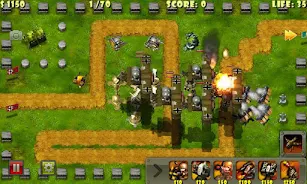
Little Commander is a casual tower defense game that puts you in charge of a small squad defending against waves of enemy forces in a stylized wartime setting. Designed for mobile play, Little Commander focuses on quick tactical decisions rather than complex simulation: drag-and-drop turret placement, pinch-to-zoom battlefield navigation, and simple upgrade taps let new players start planning defenses within minutes while still offering room for strategic depth over time.
Key features
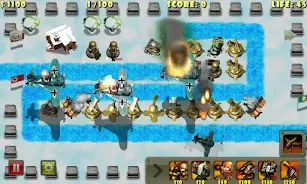
The game offers six upgradable turret types, each with a clear tactical role ranging from rapid-fire light guns to slow but devastating artillery and utility units that apply special effects like area suppression or slowing. Seventy-five handcrafted levels are grouped into themed blocks with three distinct terrain palettes that change line-of-sight and chokepoint behavior. Ten enemy unit types, occasional bomber events, and special wave conditions require adapting turret choices and upgrade priorities as you progress. Menus and tooltips are available in English, 简体中文, 正體中文, 日本語 and 한국어 to help international players navigate the interface.
Gameplay and controls
Gameplay centers on straightforward mechanics that remain engaging: build turrets on valid nodes, upgrade them when resources allow, and reposition your focus using touch gestures. Controls are optimized for handheld devices: drag a turret icon to place it, swipe to pan across larger battlefields, pinch to zoom for situational awareness, and tap units to inspect stats or apply upgrades. Sensitivity settings for zoom and pan are configurable so players can tailor responsiveness to their device or personal preference. The first levels introduce controls gradually so new players can learn by playing rather than reading extensive tutorials.
Progression and customization
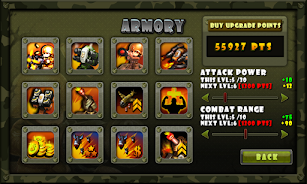
Progression is driven by in-level earnings and clear upgrade tiers rather than an overwhelming tech tree. Each turret has a linear set of upgrade options that increase damage, range, rate of fire, or add special effects like splash damage or target prioritization. Upgrades are presented as distinct choices at each tier so you can prioritize the attributes that match your playstyle. Over time, unlocking higher upgrade tiers reshapes how basic turrets behave and encourages experimentation with mixed loadouts to handle diverse enemy compositions.
Levels, modes and challenge
The seventy-five levels introduce enemy behaviors and environmental features incrementally, encouraging players to learn patterns and test different strategies. Little Commander includes three play modes to suit different moods: Normal campaign mode for steady progression, Endless mode for persistent survival and local score-chasing, and Single Life mode for a permadeath-style challenge where mistakes are costly. Difficulty spikes come from special waves and bomber strikes that change the tempo of a level, creating moments that reward quick adaptation and smarter placement.
Visual style, audio and accessibility
The visual approach favors a low-detail, cartoon-like aesthetic that keeps the battlefield readable on small screens and reduces visual clutter. Art and sound draw inspiration from historical themes while remaining intentionally stylized and approachable. Sound effects emphasize atmosphere rather than strict realism to support a lighter tone. Accessibility options include adjustable UI text size, icon contrast modes, and control sensitivity tweaks so players with different needs can tune the experience for comfort and visibility.
Replay value and offline play
Replayability comes from testing new turret configurations, aiming for higher waves in Endless mode, and revisiting early stages with freshly unlocked upgrades to improve completion efficiency. Local scoring and personal bests give players a way to measure improvement without requiring online features. Little Commander is fully playable offline with progress and unlocks stored locally, letting you play on commutes or in places without reliable internet access.
User experience and known limitations
The interface is built for short sessions and long plays alike: clear visual indicators, concise tooltips, and an autosave system preserve progress between sessions. While the game emphasizes approachability and a smooth mobile experience, players seeking a deep, simulation-style strategy title may find the mechanics intentionally streamlined. The current release focuses on a polished core loop and seventy-five levels; additional content and balance updates may arrive in future updates based on player feedback.